
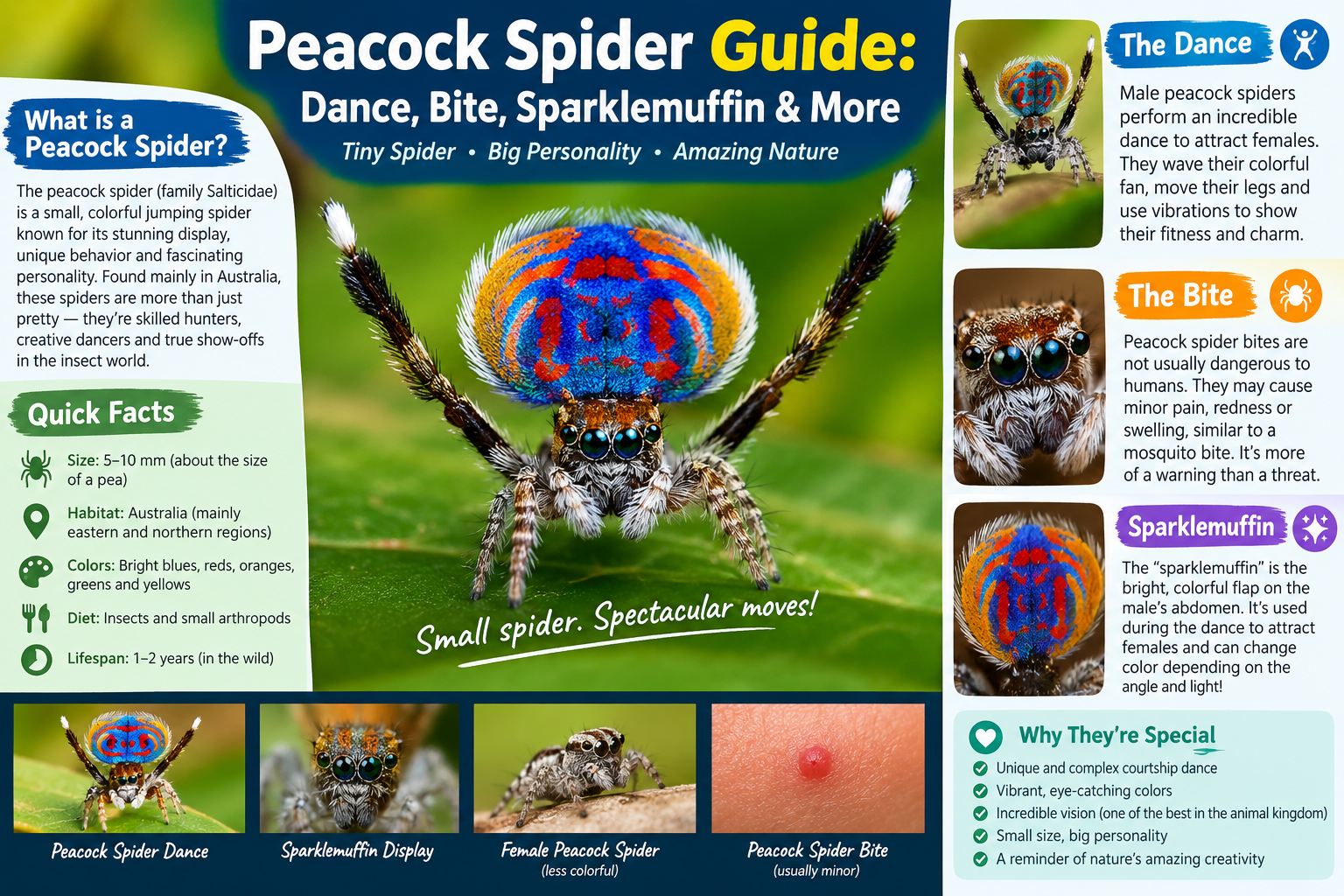
The peacock spider is one of nature’s most surprising little creatures. It is tiny, colorful, and famous for its dramatic courtship dance. These spiders belong mainly to the Maratus group of jumping spiders. They are found mostly in Australia, where many species live in forests, grasslands, and other dry habitats.
Unlike large spiders that may frighten people, these tiny spiders often look almost magical. Males can raise colorful body parts while moving their legs and abdomen. They use these movements to attract females. Their displays can look like a miniature stage performance.
Many people search for the peacock spider dance because of this behavior. Others want to know about the peacock spider bite, the unusual Sparklemuffin species, or the famous Lightsaber spider. This guide explains all these topics in simple language. It also covers their appearance, habitat, food, behavior, life cycle, and safety.
What Is a Peacock Spider?
The peacock spider is a small jumping spider known for bright colors and complex courtship displays. Most belong to the genus Maratus, which contains many small Australian species. Their name comes from the colorful males that spread parts of their abdomen during courtship.
These spiders are extremely small. Many are only a few millimeters long. Their size makes their behavior even more impressive. A male may wave his legs, move from side to side, and lift his abdomen during a display.
Jumping spiders do not build large webs to catch prey. Instead, they use excellent eyesight and quick movements. They often stalk small insects and other tiny creatures. Their large front-facing eyes help them judge distance and movement.
Peacock Spider Biography and Quick Facts
Although a spider does not have a biography like a person, a fact table makes its story easier to understand. The details below summarize important features of these remarkable animals.
| Feature | Details |
| Common name | Peacock spider |
| Main group | Jumping spiders |
| Genus | Maratus |
| Family | Salticidae |
| Main range | Australia |
| Size | Usually only a few millimeters |
| Diet | Small insects and other tiny prey |
| Hunting style | Active hunting |
| Web use | Mainly for safety and shelter, not prey trapping |
| Famous behavior | Courtship dance |
| Famous species | Sparklemuffin and Lightsaber |
| Vision | Excellent for a spider |
| Movement | Walking, jumping, and rapid body movements |
| Venom | Present, as in spiders |
| Threat to humans | Generally very low |
| Main purpose of male display | Attracting females |
| Reproduction | Sexual reproduction |
| Conservation concern | Depends on individual species and habitat |
Where Do Peacock Spiders Live?
Peacock spiders are strongly associated with Australia. Different species occupy different local habitats. Some may live among leaf litter, while others occur around grasses, shrubs, woodland, or open ground.
Their tiny bodies allow them to use very small spaces. A patch of leaves can provide shelter and hunting ground. Small plants can also give them places to climb and display.
Their distribution is not the same for every species. Some Maratus spiders have very limited ranges. Others occur across wider areas. This makes careful species identification important.
Australia’s varied landscapes provide many environments for jumping spiders. Seasonal conditions can also affect when these animals are easier to find. Researchers and photographers often spend considerable time searching through vegetation and leaf litter.
What Makes the Peacock Spider So Colorful?
The male’s bright appearance is one of its most famous features. Depending on the species, the body can show shades of red, orange, blue, green, black, white, or metallic colors.
These colors are not simply decoration. They can play an important role in courtship. A male needs to catch the attention of a female. His colorful body and movement work together during the display.
Some species have movable abdominal flaps. The male can raise these structures during courtship. This makes the display appear larger and more dramatic.
The exact colors and patterns vary between species. That variety is one reason spider researchers and photographers find Maratus so interesting. Each species can have its own visual style.
What Is the Peacock Spider Dance?
The peacock spider dance is a male courtship performance. It is designed to attract a female and show that the male is a suitable mate.
A male may move his body from side to side. He can wave his legs and lift his colorful abdomen. Some species also use vibrations and other signals.
The dance is not just a single repeated routine. Different species have different displays. Even individuals may change their movements depending on the situation.
The female watches the male closely. If she is not interested, she may move away. In some species, the male faces serious danger if his display fails.
This behavior shows how complicated animal communication can be. A creature only a few millimeters long can perform a surprisingly detailed sequence of movements.
Why Does the Male Peacock Spider Dance?
The main reason is reproduction. Male jumping spiders need to convince females to accept them as mates. Visual signals help the female identify and assess the male.
The male’s movements can communicate several things at once. His colors may show his identity. His movements can demonstrate fitness and coordination. Vibrations may add another layer to the signal.
Courtship also has risks. A female may reject a male. In some jumping spiders, females can even attack males. Therefore, successful courtship requires careful behavior.
The peacock spider dance is an excellent example of sexual selection. Over many generations, traits that help males attract mates can become more noticeable. This helps explain why some species evolved such bright colors and complex displays.
Sparklemuffin Peacock Spider: What Is It?
The sparklemuffin peacock spider is a famous species of Maratus. Its scientific name is Maratus jactatus. The spider became popular because of its striking appearance and unusual name.
The nickname “Sparklemuffin” was created by a scientist who helped describe the species. The playful name attracted public attention to an otherwise tiny animal.
Like other peacock spiders, the male uses visual movements during courtship. Its colorful body makes the display especially memorable.
Sparklemuffin is a good example of how scientific discoveries can capture public imagination. A tiny Australian jumping spider became an internet favorite because of its colors, behavior, and funny common name.
What Is the Lightsaber Peacock Spider?
The lightsaber peacock spider is another popular name connected with the colorful Maratus group. The name refers to a dramatic visual feature or display associated with a particular species.
Peacock spider names can sometimes be informal rather than official scientific names. This can create confusion online. A nickname may become popular before readers understand which scientific species it represents.
When researching these spiders, the scientific name is therefore more reliable than a colorful nickname. It helps researchers identify the exact animal being discussed.
The Lightsaber name shows how imaginative spider names can become. These tiny creatures have inspired names based on pop culture, food, colors, and unusual shapes.
Can a Peacock Spider Bite?
People often search for a peacock spider bite because they wonder whether these colorful spiders are dangerous. In normal situations, they pose very little risk to people.
Like other spiders, they have venom used to subdue tiny prey. However, their small size and lifestyle make them poorly suited to harming humans.
These spiders are not known for attacking people. Their first choices are usually hunting, hiding, jumping away, or escaping. A person should still avoid deliberately handling any wild spider.
If an unknown spider does bite, basic first aid is sensible. Clean the area and watch for unusual symptoms. Seek medical care if significant pain, swelling, breathing problems, or other serious symptoms develop.
Are Peacock Spiders Dangerous?
For most people, peacock spiders are not considered dangerous. Their tiny bodies and harmless lifestyle make them much more interesting than threatening.
They are predators, but their prey consists of very small animals. They do not hunt humans or large animals.
Their defensive behavior usually involves escaping rather than attacking. A jumping spider may suddenly leap away when it senses movement.
It is still wise to treat wild animals respectfully. Avoid squeezing, trapping, or touching unfamiliar spiders. A close-up photograph can provide a safer way to appreciate their colors and behavior.
The peacock spider bite is therefore mainly a curiosity rather than a major everyday concern. Their reputation comes from their unusual appearance, not from dangerous behavior.
How Big Is a Peacock Spider?
Peacock spiders are extremely small. Many adults measure only a few millimeters in body length. Their tiny size makes them difficult to spot without careful searching.
A macro camera can make them appear much larger than they really are. Close-up photographs reveal details that the human eye might miss.
Their small bodies also make their dances impressive. A male may perform complex movements while standing on a surface smaller than a fingertip.
Size varies between species. Females can also look very different from males. In many cases, males have the brighter colors because their appearance plays a major role in courtship.
This size difference is important when identifying these spiders. A photograph should ideally show several body features rather than relying only on color.
What Do Peacock Spiders Eat?
The peacock spider is an active hunter. Instead of depending on a large sticky web, it searches for small prey.
Jumping spiders have excellent eyesight. They can notice movement and carefully approach their target. Once close enough, they can make a quick jump.
Their food can include tiny insects and other small arthropods. The exact diet varies with habitat and prey availability.
Their hunting style is another reason jumping spiders are fascinating. They combine vision, movement, and precise jumps rather than simply waiting in a web.
They also use silk for practical purposes. Silk can provide safety lines and shelter. It can help the spider remain secure while moving around its environment.
How Does a Peacock Spider Jump?
Jumping spiders have an unusual way of moving their legs. They can use changes in internal body pressure to extend their legs rapidly.
This allows them to make surprisingly quick jumps. A jump can help them capture prey or escape danger.
The peacock spider does not need long legs like some larger jumping spiders. Its compact body is well suited to moving across small surfaces.
Before jumping, the spider can carefully watch its surroundings. Its excellent vision helps it judge where to move.
This combination of vision and movement makes jumping spiders successful hunters. Their behavior also explains why they can be fascinating to watch through a macro camera.
How Do Peacock Spiders Communicate?
Communication is central to their courtship. Males use visual signals and movements to communicate with females.
The display can involve waving legs, moving the body, lifting colorful structures, and producing vibrations. These signals work together rather than separately.
Different species have different communication styles. This is one reason scientists study individual species carefully.
Communication also helps explain the evolution of their colorful bodies. If females prefer certain signals, males with those traits may have better mating opportunities.
The result can be spectacular. What looks like a simple dance to us may contain important information for another spider.
Peacock Spider Life Cycle
The life cycle begins when a female accepts a male and mating occurs. The female later produces eggs and protects them inside a silk retreat.
Young spiders emerge much smaller than adults. They gradually grow through several stages. Like other spiders, they must shed their old outer covering as they develop.
Young spiders may look different from mature males. The brilliant adult colors often become more noticeable later in life.
The timing of reproduction can vary between species and locations. Weather, food, temperature, and habitat conditions can all influence spider activity.
Because these animals are so small, much of their early life can go unnoticed. Careful field research helps scientists learn more about their development and behavior.
Male vs Female Peacock Spider
Male and female peacock spiders can look very different. This difference is called sexual dimorphism.
Males are often more colorful. Their bright patterns and movable body structures help during courtship.
Females are commonly less flashy. Their appearance can provide better camouflage while they hunt or protect eggs.
This contrast has an important biological purpose. A male benefits from being noticed by females. A female may benefit from staying less visible to predators.
However, appearance varies among species. Not every Maratus species follows exactly the same pattern.
When identifying a peacock spider, it is useful to consider body shape, markings, location, behavior, and scientific descriptions together.
Where Can You See Peacock Spiders?
Australia is the best-known home of these remarkable spiders. Finding one in the wild can be challenging because they are so small.
Look carefully around suitable vegetation and leaf litter. A macro lens can help reveal details that are difficult to see from a normal distance.
Never disturb habitat just to find a spider. Turning over leaves or moving plants aggressively can harm small animals and their shelters.
Photography is one of the safest ways to appreciate these spiders. A respectful observer can watch their movements without touching them.
If you encounter one, give it space. The best wildlife experiences usually happen when the animal behaves naturally.
Why Are Peacock Spiders Important?
Small predators play useful roles in ecosystems. Peacock spiders help control populations of tiny insects and other arthropods.
They are also part of Australia’s remarkable biodiversity. Their specialized courtship behaviors show how many different survival strategies can evolve in nature.
Scientists can learn important lessons from studying them. Their vision, movement, communication, and mating behavior all provide useful research opportunities.
Their popularity also creates an opportunity for education. People who discover the peacock spider through photographs often become interested in spiders and biodiversity.
That curiosity can lead to greater respect for small animals. Not every spider needs to be feared. Many are simply fascinating parts of the natural world.
How to Photograph a Peacock Spider
Photographing a peacock spider requires patience. Their tiny size makes macro photography especially useful.
Move slowly when approaching. Sudden movements can cause the spider to jump away.
Natural light can help reveal body colors. A macro lens or close-focus camera can capture details that ordinary photography misses.
Avoid touching or moving the spider for a better photograph. Let it remain in its natural environment.
A series of photographs can be more useful than one image. Different angles may reveal markings, body structures, and movement.
If you share photographs online, include the location only when appropriate. Avoid revealing sensitive locations for rare species that could be disturbed by heavy collecting or tourism.
Interesting Peacock Spider Facts
The peacock spider combines several unusual traits in one tiny body. It has excellent vision, impressive jumping ability, and complex courtship behavior.
Some males have colorful abdominal patterns that become visible during displays. They can also move their legs in precise ways.
The group includes many species, and researchers continue to learn about their diversity. Some have gained memorable nicknames because of their appearance.
Their famous dances have helped change public attitudes toward spiders. Instead of seeing every spider as frightening, people can appreciate their behavior and beauty.
Perhaps the most surprising fact is their size. Their spectacular displays happen on a miniature scale.
That contrast makes them especially fascinating. A spider only a few millimeters long can perform a courtship routine that looks almost theatrical under a macro lens.
Frequently Asked Questions About Peacock Spiders
1. Are peacock spiders poisonous?
People often use “poisonous” and “venomous” as if they mean the same thing. Spiders are generally described as venomous because they inject venom through specialized structures. Peacock spiders have venom for dealing with small prey. They are not considered a significant danger to humans. Their tiny bodies and natural behavior make encounters with people very different from encounters with larger medically important spiders. Still, wild animals should not be handled unnecessarily.
2. Can a peacock spider bite a human?
A peacock spider bite is possible in the broad sense that spiders possess mouthparts and venom. However, these tiny spiders are not known for seeking out humans or behaving aggressively toward them. Their normal response to danger is often to escape. If an unknown spider causes a bite, clean the area and monitor it. Get medical help if serious symptoms appear.
3. Why do peacock spiders dance?
The peacock spider dance is mainly a mating display. Males use movement, color, and other signals to attract females. The female watches the performance and decides whether to accept the male. This behavior is an example of sexual selection. Different species have developed different displays, making the group especially interesting to scientists and wildlife photographers.
4. What is the Sparklemuffin peacock spider?
The sparklemuffin peacock spider is Maratus jactatus, a colorful Australian jumping spider. Its playful common name helped make it famous outside scientific circles. Like other members of its group, the male has a distinctive courtship display. Sparklemuffin shows how a tiny species can become widely known when unusual biology meets memorable photography and naming.
5. What is the Lightsaber peacock spider?
The Lightsaber name is a popular nickname associated with a colorful Maratus spider. Such names can make individual species easier for the public to remember. However, common names can sometimes cause confusion. Scientific names are more dependable when identifying a particular species. The Lightsaber nickname reflects the creative ways people describe unusual spider colors and structures.
6. Are peacock spiders good pets?
Keeping wild peacock spiders as pets is generally not a good idea. They are tiny animals with specialized environmental needs. Their natural hunting behavior and life cycle are difficult to reproduce properly in a simple enclosure. The best way to enjoy them is through responsible observation and photography. Leaving wild spiders in their habitat also helps preserve their natural behavior.
Conclusion:
The peacock spider proves that amazing wildlife does not have to be large. These tiny Australian jumping spiders have colorful bodies, sharp vision, impressive jumps, and remarkable courtship displays.
Their famous dances help males attract females. Their unusual names, including Sparklemuffin and Lightsaber, have made them internet favorites. At the same time, their biology gives researchers valuable insight into animal communication and evolution.
The peacock spider bite is not something most people need to fear. These spiders are far more interesting than dangerous. If you ever see one, give it space and observe it carefully.